
A post after some silence, but not inactivity.
a sound that must have existed eons before
I got here
~Vidhu Aggarwhal “The Extinction Room” (Kāmaʻo)
Let’s begin with the universal solvent,
the water, H2O, waters, origins,
polarity, attraction,
the high specific heat, the surface tension,
the ability to climb.
From waters we come, on water we depend.
And when I say we, I mean all of us, earth’s living, past and present, all Delisted 2023’s entangled human and nonhuman beings, those named and unnamed.
Every inhalation is an act of hope because it is porosity. Because it is necessary. Every exhale an act of peace.
~DULSE “filter feeding poems for filter feeders” (pearly mussels)

Let me tell you a story.1
Water is of the stars and the newly formed planets. And, once upon a time, maybe 4 billion years ago, maybe 4.4 billion years ago, almost at the beginning of earth’s time in the universe, there was water.
Less than a billion years later, before the atmosphere was full of oxygen, the Last Universal Common Ancestor, LUCA, came to being in water, lived in the waters, and spread throughout the Hadean Sea.
LUCA used the Universal Genetic Code that all earthlings share and the same basic metabolic framework to access energy.
At the time, there was not enough oxygen to support aerobic respiration, so LUCA did not rely on oxygen, but instead on other elements like sulfur.
In some narratives, they were metabolically flexible allowing them to live almost everywhere at the time, on that new, watered, and dynamic earth.
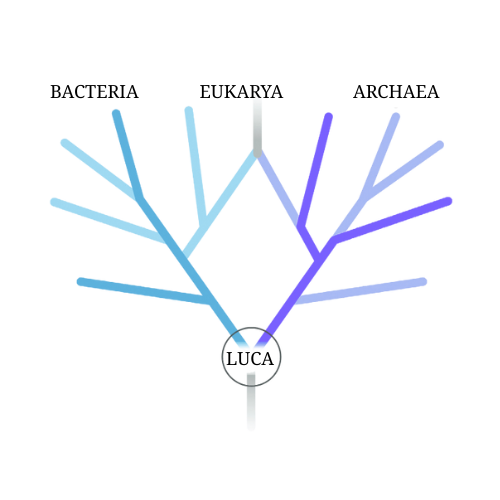
From LUCA came everyone, the Archaea, the Bacteria and the Eukarya.2
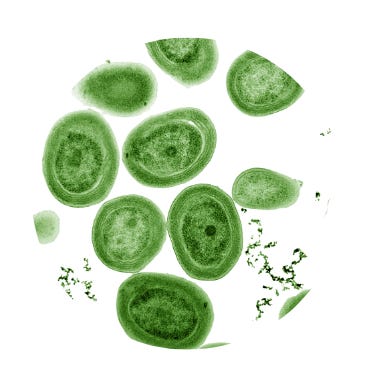
About 2.7 or so billion years ago, one group of LUCA’s offspring, the cyanobacteria3, started producing oxygen during cellular respiration. The individual and colonial members of these species spread and in the span of 400 million or so years contributed enough oxygen to the atmosphere that they remade the world.
This remaking was disruptive and creative, as things are. Many of the microbial organisms of the time died because of exposure to rising oxygen levels, so the Great Oxidation Event caused extinctions or relegated individual microbes (our siblings) to places on the planet where oxygen remained in short supply such as deep sea trenches.
This new world also gave space to new forms, including everyone explicitly named as a part of Delisted 2023. The Eukarya came to be when their older siblings engulfed one another and developed endosymbiotic relationships.4
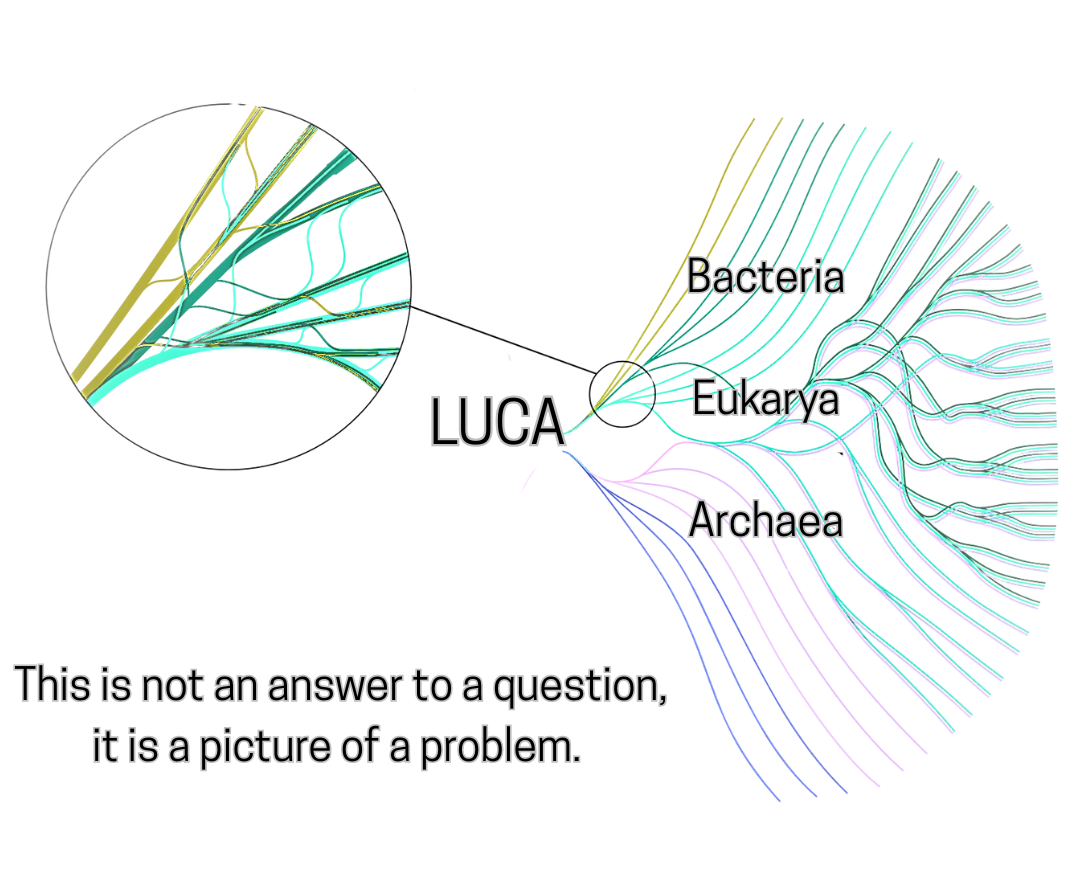
LUCA’s descendants that populated the earth before the oxygenated atmosphere were prokaryotes, members of the domains Bacteria and Archaea.
All of Delisted 2023 carry these relationships in the membrane of our nucleus, our mitochondria, and for some of us, our chloroplasts.4
For some time we were together as Eukarya. Then came the splitting.
& we replied yes
                             we have sorted them two by two
~Kimberly Quiogue Andrews, "Kaua'i 'akialoa” (Kaua’i ‘akialoa)
First the plants from the animals and fungi.
Then the animals from the fungi.
And then the animals from from each other, invertebrates from vertebrates. The invertebrates emerging into new forms distinct. The vertebrates emerging into new forms distinct.
no thing / not anything / not something
not one thing /
~Lisa Olstein, "nothing [ a prosimetric form ]" (San Marcos gambusia)
The explicitly named members of Delisted 2023 include plants, mammals, fish, birds, and bivalves. These are named because they are perceptible as entities subject to the ESA.
The unnamed members include unicellular animals, fungi, members of Archaea and Bacteria. They are not generally perceived by the ESA.
          If they dream of you
then I can’t write about you

without writing about them
~Cecily Parks, "Amistad gambusia" (Amistad gambusia)5
All of us, the named and unnamed of Delisted 2023, share the memories of our ancestors as part of their community of living and nonliving beings —through the accidents of evolution, the imprints of epigenetics, and the many other ways a living being gifts memories of their experiences to their offsprings.
We have experienced billions of years together on this shared earth—we have over three billion years of shared memories.
We are all new together and we are all so old.
I believe in you. I see traces of you everywhere.
~Alissa Hattman "Traces" (Kaua’i ʻōʻō)
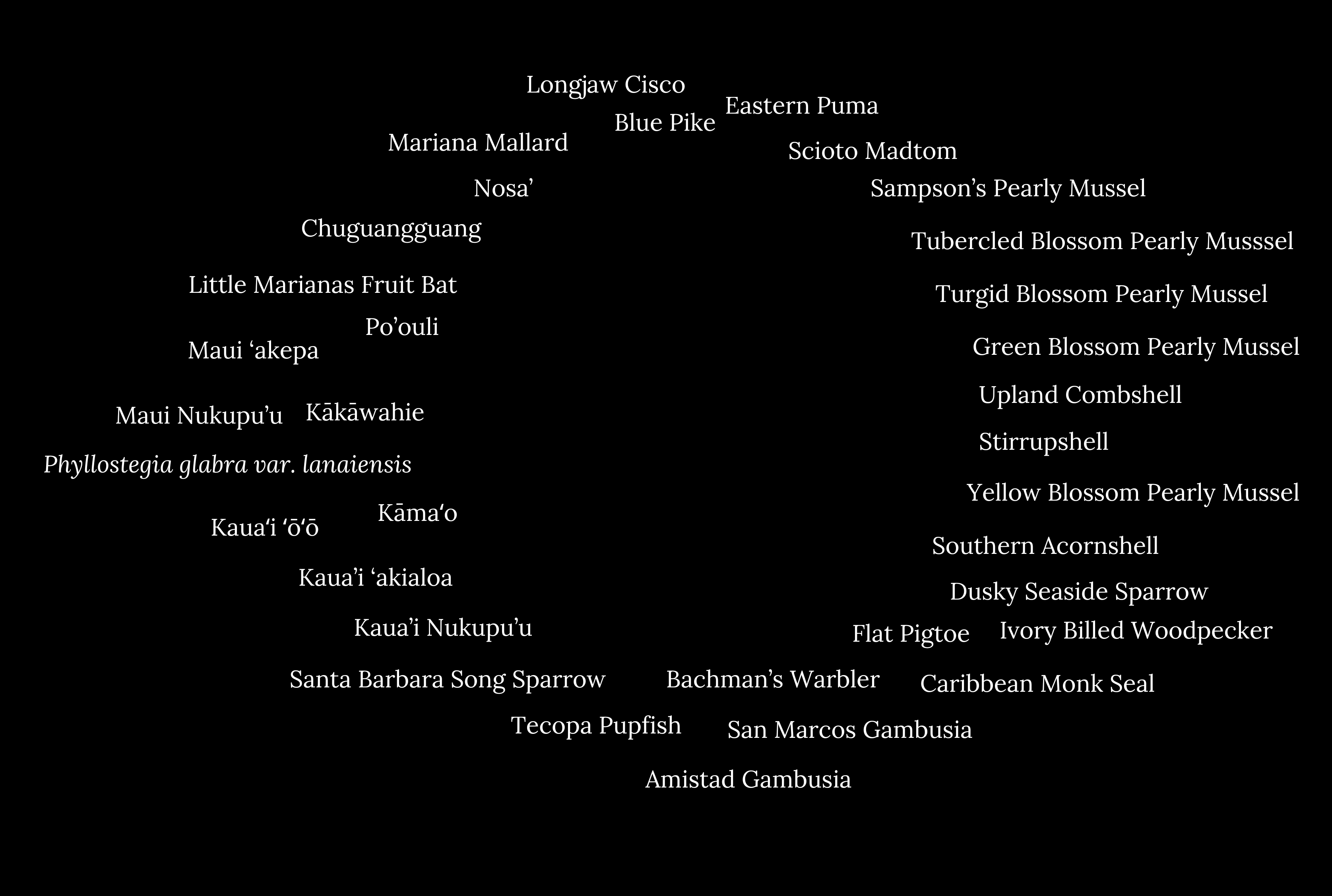
I’ve sought them in the pages of my books, and in the cut over forest, looked for them in the still and rushing waters, and along the slopes of quiescent volcanoes. What I learned is that I once lived with them but by the time I knew they were there, it was too late. ~Jennifer Calkins, “Delisted 2023” (everyone)
This post is the first of more frequent posts about Delisted 2023 as the project moves from a contemplative, processing stage, a stage where artists worked with their species to create, outwards.
Included here are excerpts from poems and essays by Delisted 2023 artists that will be included in the collection to be published in 2026 by the 3rd Thing Press. Some have already appeared in other spaces. I identify the species or group the artist is working with in parenthesis after the name of the piece.
Where Can You Find Delisted 2023?
As an emergent project, Delisted 2023's shape is not predefined but comes to be through the creation of the artists, and all of our contexts.
Published by literary and other presses. Amistad gambusia (Cecily Parks, The Nation, May 2025), tubercled blossom pearly mussel (Mandy-Suzanne Wong, Cincinnati Review, July 2024) Hawaiian honeycreepers esp. the kākāwahie (Lyz Soto, poem-a-day, May 2024), tubercled blossom pearly mussel (Gretchen Primack, About Place Journal), Upland Combshell (Megan Kaminski, ISLE, 2024), Dusky seaside sparrow (Sandra Simonds, Seneca Review Fall 2023)
Performed. Bachmann’s warbler (Jonathan Skinner), Santa Barbara song sparrow (Eleni Sikelianos), (Mariana mallard) Sarah Falkner, Kauaʻi ʻōʻō (Alissa Hattman), stirrupshell (Madhur Anand), all the beings (Adriene Jenik), green blossom pearly mussel (Madeline Bassnett), tubercled blossom pearly mussel (Joanna Lilley)
As an installation: yellow blossom pearly mussel (Summer J. Hart)
As a ceremonial: Phyllostega glabra var. lanaiensis (Art 25)
Pre-dating, influencing, and accompanying: Caribbean monk seal (Alexis Pauline Gumbs), 23 species proposed for delisting in 2021 (Heather Kerley)
On its website6:
Slowly re-emerging! Please be patient as I build it back from the ground up: https://delisted2023.com/
One context to the project is the U.S. political environment.
The U.S. in politics and law has never worked for nonhuman bodies.
It has aspired, however, through modifications, additions such as the ESA, and other ways, to incorporate some degree of caretaking for the more than human world into the existing structures.
Always, this caretaking is met with opposition and the ESA has been under attack since implementation.
Given the current fascist U.S. administration, I believe generally, that it is necessary for us to hold two things in our mind at once.
First: The ESA provides the most powerful available protection for certain species.
Second: The ESA and its implementation are embedded in structures of power and systems that operate against nonhuman life.
We should fight for the ESA and the federal workers that have and continue to try to implement it and we should imagine and prepare to build something better in its place.
In other words, we need to retain our connection to the world and each other. And we need to imagine the new world.
Delisted 2023 Invitation
This post started with a story about our common origins in the context of time.
I invite you to revisit that deep time story and to write, draw, or make in some other way as you read
I also invite you, if you want, to send me what emerges for you and I will include it in the collection of “creative comments” that I will be submitting on May 19, 2025, in response to the proposal to rescind the definition of “harm” under the ESA. You can email me here: jen@delisted2023.com. I recognize this does not give you much time but this is not about creating something perfect.
For more information about this invitation, creative commenting, and the administration’s proposal, follow this link:
This is a story about all life’s lineage based on western science which reveals more things unknown even as it suggests certain shapes for the world, past, present, and future.
Image adapted from Weiss, M. C., Sousa, F. L., Mrnjavac, N., Neukirchen, S., Roettger, M., Nelson-Sathi, S., & Martin, W. F. (2016). The physiology and habitat of the last universal common ancestor. Nature microbiology, 1(9), 1-8. https://www.molevol.hhu.de/fileadmin/redaktion/Fakultaeten/Mathematisch-Naturwissenschaftliche_Fakultaet/Biologie/Institute/Molekulare_Evolution/Dokumente/Weiss_et_al_Nat_Microbiol_2016.pdf
The cyanobacteria are multiple species of blue-green algae that can live on earth and in fresh and saltwater. They continue to produce a huge proportion of earth's available oxygen. They impact carbon cycling, are deeply entwined in marine food webs. some fix nitrogen, making it accessible to plants. They have remarkably diverse collective behaviors including those that drive algae blooms.
Image and quote adapted from Martin, W. (1999). Mosaic bacterial chromosomes: a challenge en route to a tree of genomes. Bioessays, 21(2), 99-104. https://www.molevol.hhu.de/fileadmin/redaktion/Fakultaeten/Mathematisch-Naturwissenschaftliche_Fakultaet/Biologie/Institute/Molekulare_Evolution/Dokumente/67.pdf
The Nation. (April 25, 2025) https://www.thenation.com/article/archive/amistad-gambusia/
I am building this website from the ground up (so to speak) after switching web design platforms. Originally, I’d chosen Wix for Delisted 2023. Because it is an Israeli Company that has refused to oppose the genocide in Gaza I’ve moved to Wordpress. Wordpress, and for that matter Substack are still embedded in the extractive capitalist structure, and frankly suck (excuse my language) in their own ways, but they are the complicity I am choosing for this project for now.